2011年6月29日 星期三
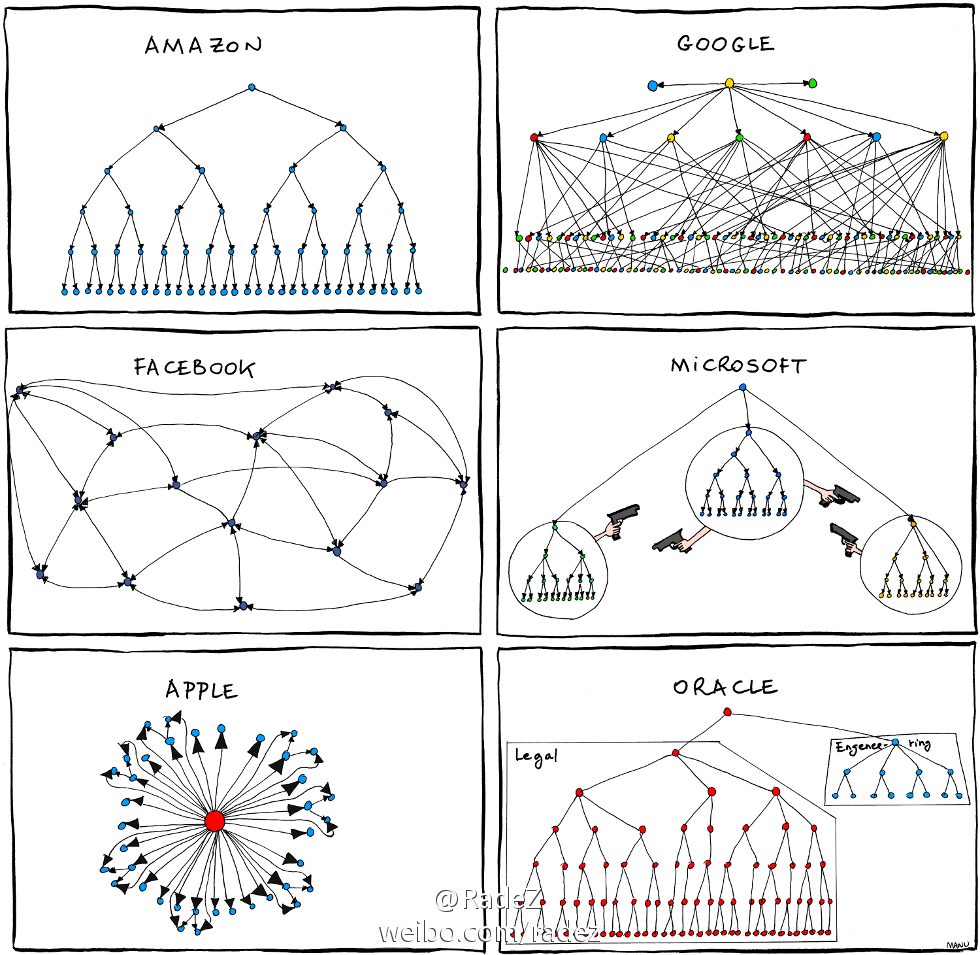
Comparing the difference organization charts between 6 companies(include amazon, google, facebook etc.

Node.js coming to Windows and Azure - Node.js news - developer Fusion
Node.js, the open-source event-based server, is set to get first-class Windows support following an announcement by Microsoft and the project’s primary sponsors, Joyent Inc.
Node.js is a server which makes use of the V8 JavaScript engine (sponsored by Google for use in its Chrome web browser) in a novel architecture in which system events drive callbacks developers implement. Using the JavaScript language, developers build code to which responds to events such as TCP or HTTP connections. Node.js then defers the notification of events to the OS and only spools up a small heap to respond when an event actually occurs. The end result is an extremely lightweight server which can handle thousands of requests per second, as well as other advantages such as code re-use between the client and server.
Node.js has supported OS X and Linux platforms since its creation; it had previously been infeasible for a native implementation for Windows to be constructed as it was a lot of work to re-implement the Node architecture to support Windows’ IOCP API (which would provide the OS-level eventing that Node’s performance relies upon).
In an announcement on their blog, Joyent’s Ryan Dahl said that Rackspace would also be contributing developer time to bring official Node.js Windows binaries to life.
2011年6月19日 星期日

2011年6月18日 星期六
Why most programmers are lousy « Salvatore Iovene
Why most programmers are lousy
I’ve been in the IT field long enough to get to know many programmers, both experienced and just wannabies. During this time, I’ve realized that most of them are just bad programmers, simply said. I find myself agreeing with a brilliant post by Jeff Atwood, which alleges that programmers can’t program. What are the reasons for this? Many. Probably, IMHO, the main fault has to be addressed to the lousy education that people receive. But then again, the ability of giving education remains directly proportional to the ability of getting it, and where I see people complaining about low quality of education in University, I also see students with no interest in learning. Let’s see some of the reasons why programmers can’t really program.

2011年6月15日 星期三
2011年6月11日 星期六
2011年6月8日 星期三

At the Boundaries, Applications are Not Object-Oriented
My recent series of blog posts about Poka-yoke Design generated a few responses (I would have been disappointed had this not been the case). Quite a few of these reactions relate to various serialization or translation technologies usually employed at application boundaries: Serialization, XML (de)hydration, UI validation, etc. Note that such translation happens not only at the perimeter of the application, but also at the persistence layer. ORMs are also a translation mechanism.
Common to most of the comments is that lots of serialization technologies require the presence of a default constructor. As an example, the XmlSerializer requires a default constructor and public writable properties. Most ORMs I’ve investigated seem to have the same kind of requirements. Windows Forms and WPF Controls (UI is also an application boundary) also must have default constructors. Doesn’t that break encapsulation? Yes and no.
Poka-yoke Design: From Smell to Fragrance
Encapsulation is one of the most misunderstood aspects of object-oriented programming. Most people seem to think that the related concept of information hiding simply means that private fields should be exposed by public properties (or getter/setter methods in languages that don’t have native properties).